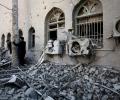
The logic of war plus the gathering storms in US politics as the midterms loom large leave him with no real alternative but to negotiate, points out Ambassador M K Bhadrakumar.

India is among six countries on the priority watch list in a US report addressing the protection and enforcement of intellectual property rights.

US President Donald Trump on Monday confirmed that a high-level American negotiating team, including Vice President JD Vance, Jared Kushner, and Special Envoy Steve Witkoff, is en route to Pakistan to initiate critical negotiations with the Iranian leadership.

Iran's foreign ministry spokesperson Esmaeil Baqaei on Sunday said that the recent meeting with US officials was the longest round of negotiations they have had in the past year.

US Secretary of War Pete Hegseth on Wednesday claimed that Tehran "begged" for a truce, maintaining that Washington achieved a "decisive military victory" during 'Operation Epic Fury.'

Iran blames the US for 'maximalism' and 'shifting goalposts' leading to the collapse of the Islamabad talks.

...reopen for up to six months. Until then, the Strait stays nearly closed. The world pays. And no one, including the man who started this, can say when it ends, notes Prem Panicker in his must read blog on the Iran War.
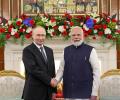
Luckily for us, a Russia that is desperate to stay relevant in an emerging multipolar world finds in India a reliable geostrategic partner. The Russian proximity to India also keeps China from exploiting its economic dominance vis a vis Russia, points out Colonel Anil A Athale (retd).

US President Donald Trump said on Wednesday that Washington is considering a "joint venture" with Iran to secure the Strait of Hormuz, following his announcement of a two-week ceasefire.

Donald Trump has expressed confidence that Tehran will engage in diplomatic talks, warning that the country will 'see problems' should it refuse to cooperate.

The popularity of US President Donald Trump is waning with approval ratings at its lowest, according to former diplomat Mahesh Sachdev, who notes that with two-thirds of Americans not approving of a continuation of the war on Iran, Trump faces the risk of being impeached.

An Iranian tanker successfully bypassed the US Navy to deliver crude oil to the Asia-Pacific region, despite ongoing tensions and a US blockade.

'As result, Netanyahu 'convinced' Trump to go to war with the help of overoptimistic Israeli intelligence assessments, essentially explaining to him that they only need to bomb Iran for 3-4 days, and the regime would then collapse.' 'Rather unsurprisingly, Netanyahu is ever since blaming his own intel service for the entire operation failing.'

US Vice President J D Vance stated that while progress was made during peace talks in Islamabad, it is now up to Iran to further the discussions and address US concerns regarding its nuclear ambitions.

Trump has said he would be present at the signing ceremony in Islamabad. Don't be surprised if the Pakistani hosts make it a grand event in the geopolitics of the region. Trump would love that, notes Ambassador M K Bhadrakumar.

The LPG squeeze on India's restaurant sector is the quotidian face of a deeper crisis.

The US Navy seized an Iranian-flagged cargo ship in the Gulf of Oman, escalating tensions as ceasefire talks face uncertainty. The incident raises concerns about the fragile ceasefire and the ongoing blockade of the Strait of Hormuz.

Amidst the stalling of high-level peace talks between Tehran and Washington, Iran continues to endure severe digital isolation as the nationwide internet blackout reached its 44th day on Sunday.

The US Central Command (CENTCOM) announced the start of operations to clear mines in the Strait of Hormuz, a claim swiftly denied by Iran, leading to increased tensions in the region amidst stalled negotiations between the two countries.

A look at some of the long-standing barriers or world records which were broken in athletics, cricket and badminton.

The delegations from the US and Iran head to Islamabad on Friday, carrying a ceasefire that is already fraying, a Strait that is technically open and practically closed, and a negotiating agenda that would challenge even parties actually negotiating in good faith, which these groups are not. Prem Panicker continues his must read blog on the Iran War.

Sri Lanka's response to the Easter attacks has been slow and politically contested, unlike India's swift institutional reforms after the 2008 Mumbai terror attacks, observes Colonel R Hariharan (retd).
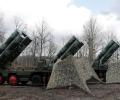
In Operation Sindoor, Pakistan had deployed additional squadrons of the Chinese-origin HQ-9 air defence systems, which could not do much against the Indian aircraft when they brought down multiple terror targets inside Pakistan.

Trump may strike. He may announce productive talks and extend again. He may do both at the same time. Iran will not open the Strait on someone else's terms, so no matter what happens, that problem will remain unsolved. And the IRGC will still be collecting its $2 million toll from every ship bold enough to ask permission to pass.

Chaffing under public ridicule in the US as well as internationally for having 'lost' the war, Trump is under immense pressure to do something, cautions Ambassador M K Bhadrakumar.
'If the Trump administration could gain access to the nuclear weapons, they would be satisfied -- at least they could control them.'

The core issues to be settled -- access to Hormuz, Israel's aggression in Lebanon, the question of Iran's nuclear programme, sanctions relief and compensation -- are thorny enough to require weeks of patient negotiation. The most likely outcome of the opening sessions is that both sides take the measure of each other, establish what is and is not negotiable, and return home without having broken anything. That would count as progress.

The US President has previously made similar claims, stating that Sharif had credited him with saving millions of lives by helping end the conflict between the nuclear-armed neighbours.

US President Donald Trump's call to Prime Minister Narendra Modi signals a concerted effort to reset strained Washington-New Delhi ties, with a focus on 'big-ticket' energy and trade deals, including increased Indian imports of US LNG and LPG, and potential cooperation on small modular reactors.

In a bid to de-escalate Middle East tensions, the US has presented Iran with a comprehensive 15-point peace plan focusing on nuclear disarmament and regional stability in exchange for sanctions relief.

Trump seems to have estimated that Ghalibaf is a pragmatic politician who is receptive to close relations with the US and is enthusiastic about fostering business and economic ties in particular, points out Ambassador M K Bhadrakumar.

'In such a scenario, Iran could proclaim itself victor, rebuild, re-enforce its diminished regional proxies to further destabilise neighbouring nations and take control of the Persian Gulf and Strait of Hormuz.'

US President Donald Trump wished Team USA luck as the ICC Men's T20 World Cup began in India and Sri Lanka, expressing confidence in the American side.

America's population and its media and its democratic structures seem fine with this, which is why Trump continues as he does, asserts Aakar Patel.

US President Donald Trump on Sunday expressed confidence that Tehran would eventually concede to American demands, while simultaneously issuing a stern warning regarding the potential for total military devastation.

Iran's Ambassador to Pakistan, Reza Amiri Moghadam, has said there are no ongoing talks between Tehran and Washington, DC, countering United States President Donald Trump's claims of peace overtures.

US President Donald Trump on Sunday announced that the American Navy will henceforth block all maritime traffic entering the Strait of Hormuz.

Trump has made it clear: the US will not lift its blockade of Iranian ports until a deal is signed.

Both sides have now revealed a preference for escalation over strategic defeat, and each new provocation narrows the space for the next pause. The Touska seizure, Iran's refusal to negotiate under blockade, Israel's strikes on Iranian oil infrastructure -- all of these add up to an increasingly untenable situation. This makes the wild card -- Trump and his motormouth -- more consequential than ever, notes Prem Panicker in his must read blog on the Iran War.

By appearing to privilege ideological affinity over strategic balance, India risks eroding the trust painstakingly built across West Asia. Once the perception takes hold that India's friendship is conditional and transactional, rebuilding credibility will be difficult, warns Amberish K Diwanji.
